
MASTER TEMPLATE – Absolute Beginner Listen & Repeat.
MASTER TEMPLATE – Absolute Beginner Listen & Repeat. Read More »
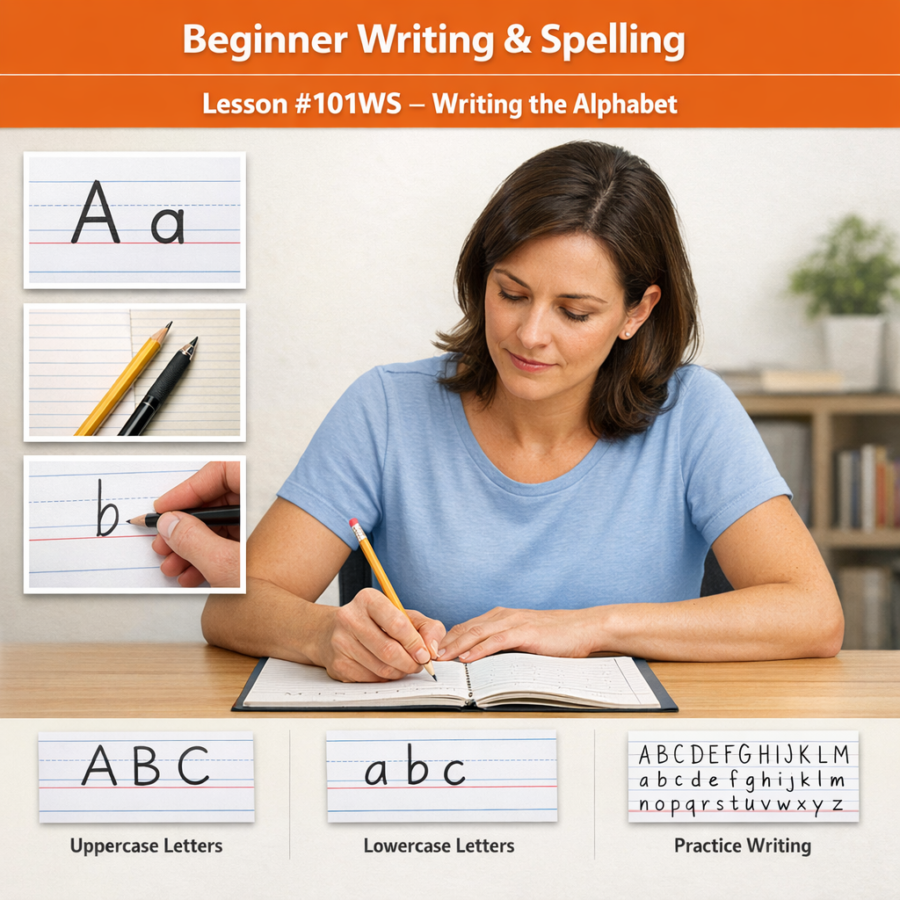
This lesson introduces students to the first half of the English alphabet (A M) with emphasis on identifying and writing each letter. Each lesson includes a short video that demonstrates the topic visually and provides guided examples to support writing
and spelling practice. This lesson is integrated with the Vocabulary, Grammar, Listening, and Speaking modules to reinforce learning through multiple skill areas
Objective: Learn to recognize and pronounce the first 13 letters of the English alphabet.
Person is a category used to distinguish between (1) those speaking, (2) those being addressed, and (3) those who are neither speaking nor being addressed (i.e., everybody else). These three categories are called the first person, the second person, and the third person.
True or false? Person is a category used to distinguish between (1) those speaking, (2) those being addressed, and (3) those who are neither speaking nor being addressed (i.e., everybody else).
True or false? The three person categories are called the first person, the second person, and the third person.
Which of the following is a first-person pronoun?
Do ALL
the
questions
 In grammar, the personal pronouns (I, you, he, she, it, we, you, they) are grouped into one of the three categories:
Read more the “first person” in grammar.
Read more the “second person” in grammar.
Read more the “third person” in grammar.
Watch a video summarizing this lesson on grammatical person.
As well as being categorized as one of three “person” categories, each personal pronoun is also categorized as either singular or plural. Therefore, there are six person categories overall.
The table below shows the pronouns in the six person categories and in the various cases.
| Person | Subjective Case | Objective Case | Possessive Determiner | Possessive Pronoun |
|---|---|---|---|---|
| First Person Singular | I | me | my | mine |
| Second Person Singular | you | you | your | yours |
| Third Person Singular | he/she/it | him/her/it | his/her/its | his/hers/its |
| First Person Plural | we | us | our | ours |
| Second Person Plural | you | you | your | yours |
| Third Person Plural | they | them | their | theirs |
Read more about the subjective case, the objective case, determiners, and possessive pronouns.
The idea of grammatical person is used in some everyday terms:
The overwhelming majority of native speakers – even those who’ve never heard the term grammatical person before – can use all the pronouns and adjectives in the table above flawlessly. Nevertheless, there are two good reasons to be familiar with the person categories.
Choose the right person? Yup, I’m still talking about grammatical person. If you want to portray a personal touch or show responsibility for your actions, write in the first person (i.e., use “I” or “we”). For example:
If you want to portray formality or distance yourself from your actions, write in the third person (i.e., use “he,” “she,” “it,” or nouns). For example:
If you really wanted to distance yourself from your actions, you could also write in the passive voice.
Read more about the passive voice.
Beginner Listen and Repeat Lesson #101LR Read More »
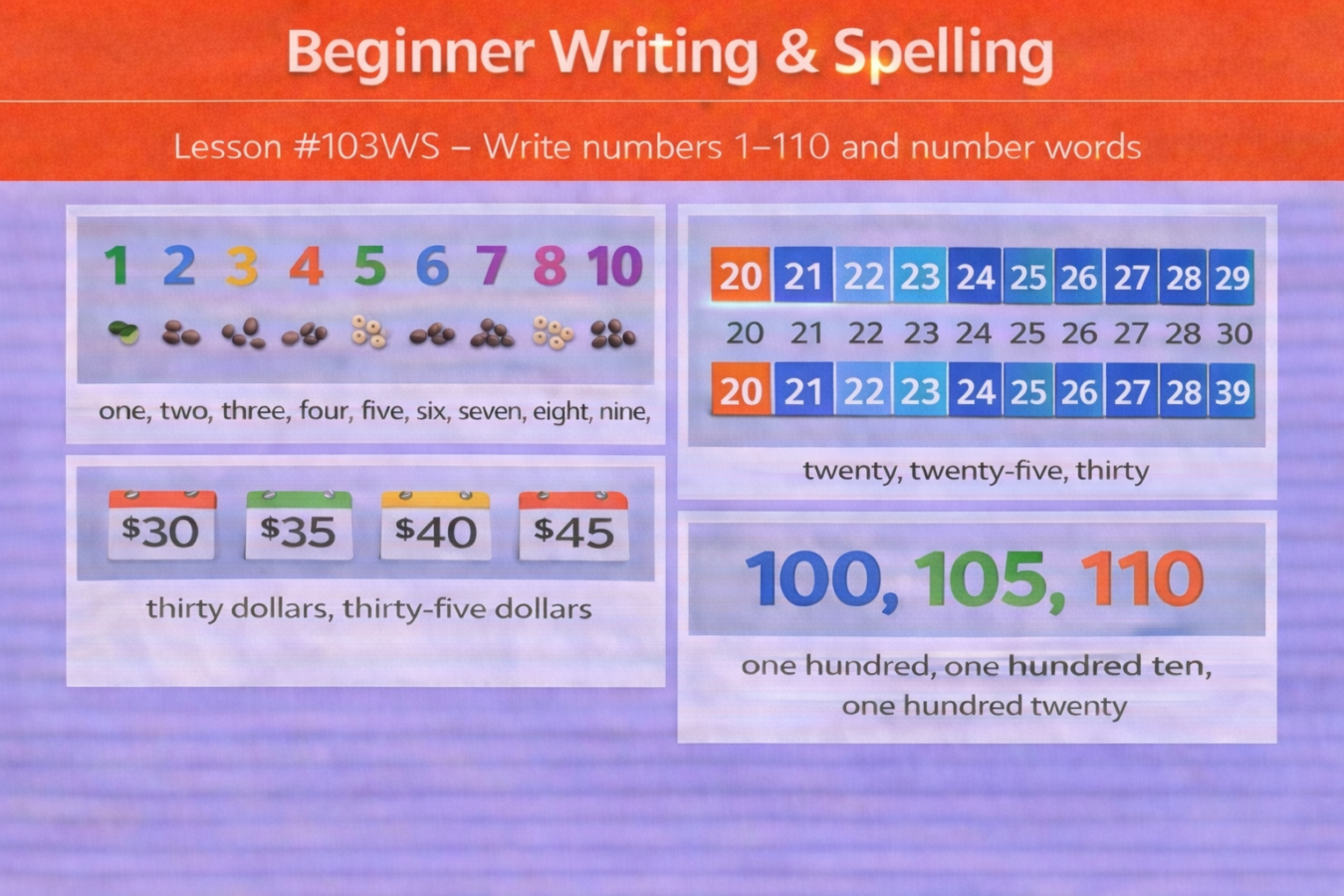
This lesson focuses on helping students distinguish vowels from consonants and understand their roles in spelling and word formation. Each lesson includes a short video that demonstrates the topic visually and provides guided examples to support
writing and spelling practice. This lesson is integrated with the Vocabulary, Grammar, Listening, and Speaking modules to reinforce learning through multiple skill areas.
Learn the Vowel Sounds
Consonant Sounds
Beginner Writing and Spelling Lesson #103WS Write numbers 1–100 and number words Read More »

In this lesson, we review the key vocabulary and grammar from previous lessons, solidifying what you’ve learned through comprehensive speaking, listening, reading, and writing exercises. This session assesses your progress and highlights areas to focus on. You’ll receive feedback to celebrate your accomplishments and guide you forward, setting the stage for future learning.
Beginner Listen and Repeat Lesson #120LR Review of Previous Lessons Read More »

In this Lesson, we learn to use the future tense (“going to” + verb) to talk about intentions and upcoming events. Practice making sentences about your future plans, with listen-and-repeat exercises that provide a strong foundation for talking about your hopes and intentions. By the end, you’ll feel confident discussing what you’ll be doing next.
Beginner Listen and Repeat Lesson #119LR The Future Tense Read More »

In this Lesson, we practice discussing daily activities in the past using the past simple tense. This lesson includes listen-and-repeat exercises that build your confidence in narrating past events, allowing you to talk about past routines and experiences in a straightforward, natural way.
Beginner Listen and Repeat Lesson #118LR Daily Activities in the Past Read More »

In this lesson, we focus on the past tense of “to be” (was, were) to describe past events and situations. This lesson provides listen-and-repeat practice with statements, negatives, and questions using “to be” in the past. By mastering this, you’ll be able to talk about past situations naturally and confidently.
Beginner Listen and Repeat Lesson #117LR Past Simple of “To B” Read More »
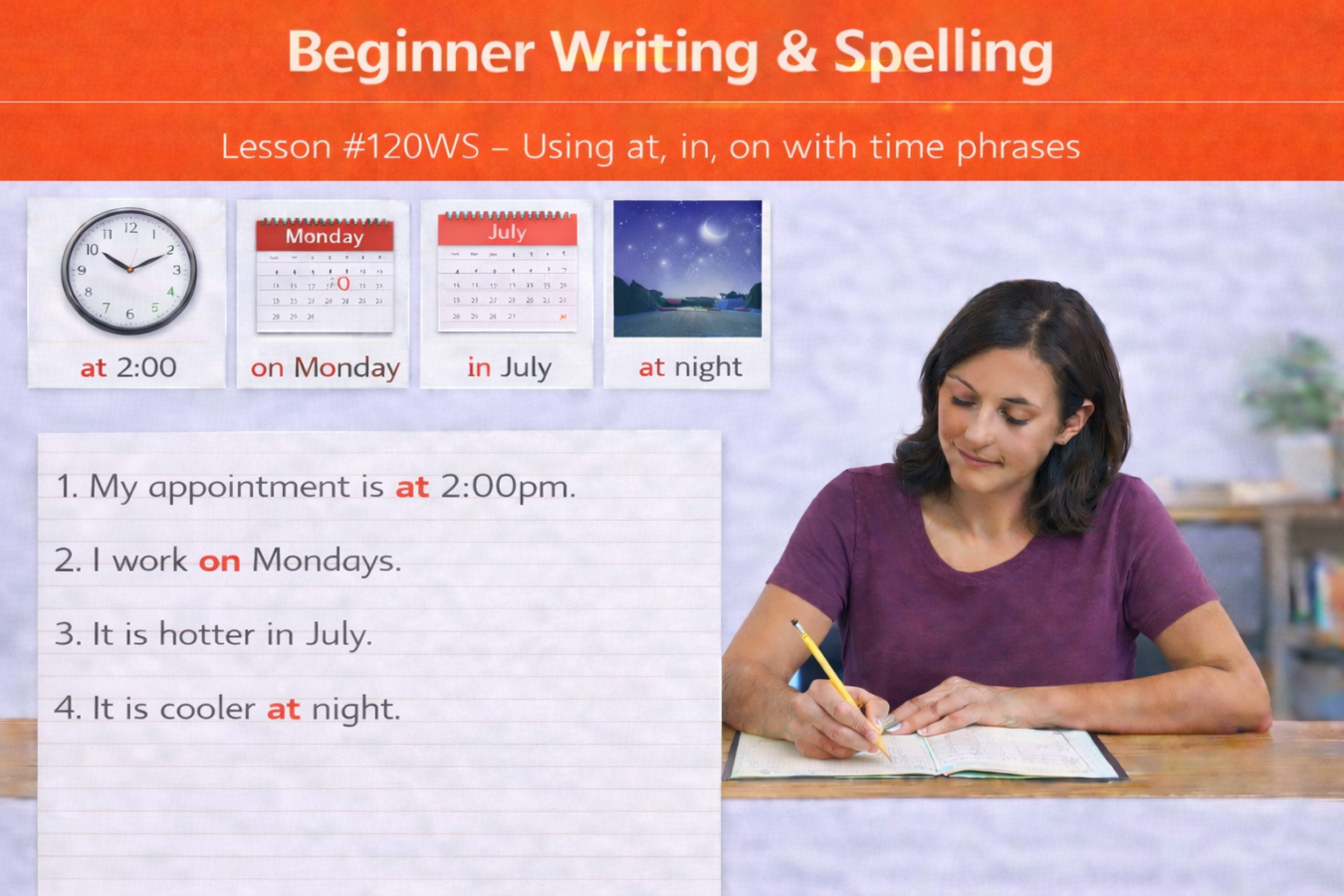
Students learn to write sentences describing past ongoing actions using the past continuous tense. Each lesson includes a short video that demonstrates the topic visually and provides guided examples to support writing and spelling practice. This lesson is integrated with the Vocabulary, Grammar, Listening, and Speaking modules to reinforce learning through multiple skill areas
